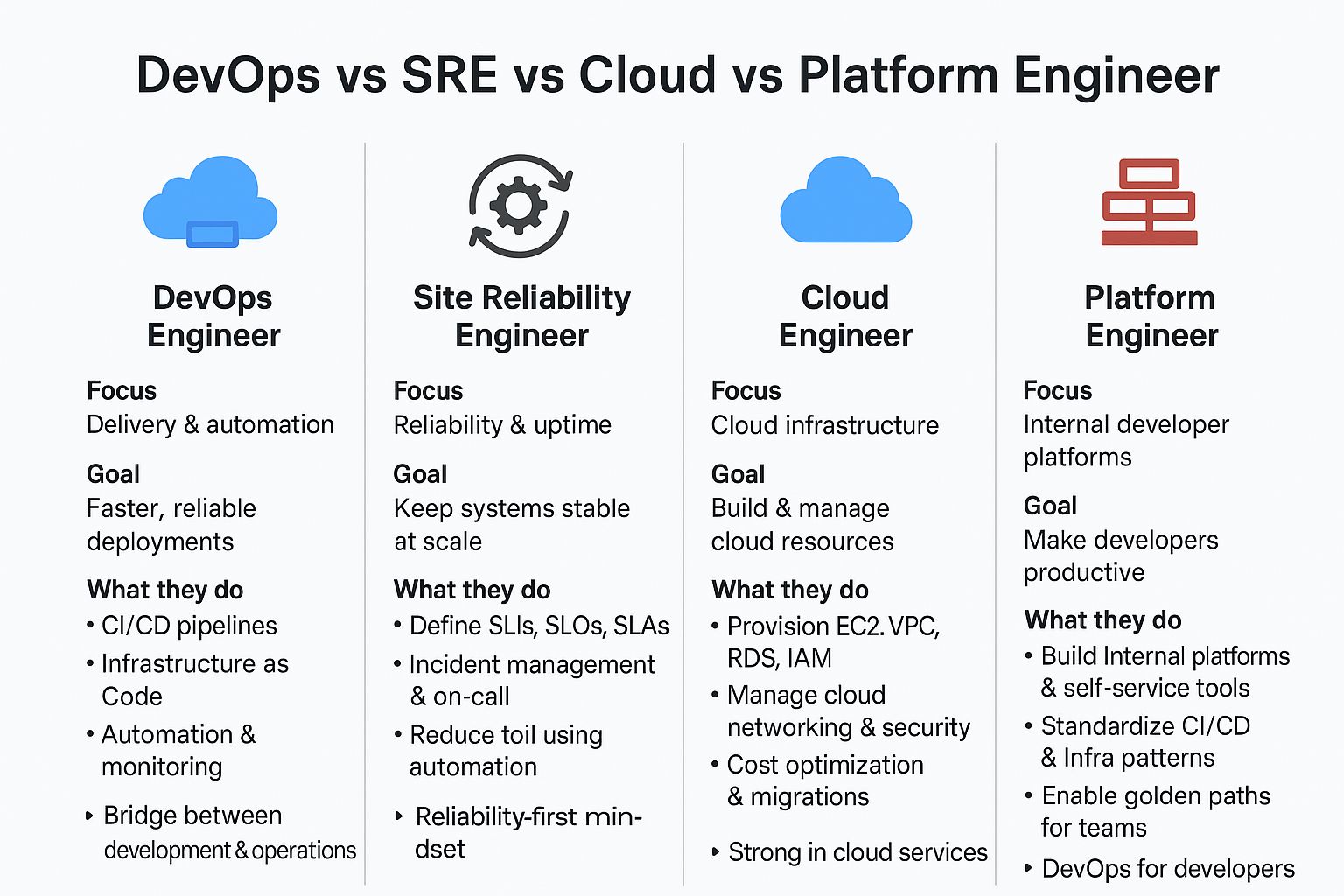
These titles overlap a lot, but they do not optimize for exactly the same outcome. The fastest way to separate them is to ask: who is the customer, what platform do they own, and which metric matters most?
Quick Read
Improves delivery flow with CI/CD, release automation, and feedback loops.
DevOps EngineerProtects service reliability with SLOs, incident response, and observability.
Site Reliability EngineerBuilds cloud foundations across networking, IAM, compute, and infrastructure as code.
Cloud EngineerCreates internal platforms and self-service paths that other engineers can reuse.
Platform EngineerShort version: DevOps improves software delivery, SRE protects reliability, Cloud engineering builds the cloud foundation, and Platform engineering turns that foundation into a product for internal teams.
Role Snapshots
DevOps Engineer
Improves the path from code commit to production by focusing on CI/CD, automation, release pipelines, environment consistency, and collaboration between development and operations.
Site Reliability Engineer
Keeps services reliable as systems scale and change by focusing on availability, latency, observability, incident response, SLOs, error budgets, and reducing operational toil.
Cloud Engineer
Builds and manages the cloud layer itself, including networking, IAM, compute, storage, managed services, infrastructure as code, account structure, and governance.
Platform Engineer
Turns shared infrastructure into a product for internal teams through paved roads, golden paths, self-service workflows, templates, runtime platforms, and developer portals.
Side-by-Side Comparison
| Dimension | DevOps | SRE | Cloud Engineer | Platform Engineer |
|---|---|---|---|---|
| Main goal | Ship faster and safer | Keep services reliable under change | Build and manage cloud foundations | Make engineers productive through self-service |
| Primary customer | Application teams | End users and service owners | Infrastructure and application teams | Internal developers and product squads |
| Typical scope | CI/CD, automation, release workflows | Monitoring, incidents, capacity, resilience | Cloud accounts, networking, IAM, Terraform, landing zones | Developer portal, templates, runtime platform, guardrails |
| Success metrics | Deployment frequency, lead time, change failure rate | SLO attainment, MTTR, toil reduction, incident rate | Availability, security posture, cost efficiency, standardization | Developer experience, adoption, time to provision, consistency |
| Common tools | GitHub Actions, Jenkins, Argo CD, Docker | Prometheus, Grafana, Datadog, PagerDuty | AWS or Azure or GCP, Terraform, IAM, VPC, Kubernetes | Backstage, Kubernetes, Terraform, Crossplane, internal CLIs |
| Mindset | Automation and collaboration | Engineering for reliability | Architecture and infrastructure stewardship | Platform as a product |
Where People Get Confused
DevOps
DevOps is often a culture first, not just a title.
Many companies hire a “DevOps Engineer” when they really need someone to own build pipelines, deployment automation, release standardization, and the handoff between software teams and operations.
Which Role Fits Best?
Choose DevOps
Pick this if you enjoy build systems, deployment automation, release quality, and improving the path from commit to production.
Choose SRE
Pick this if you like reliability engineering, incident response, observability, performance, and designing systems that stay calm during failure.
Choose Cloud Engineer
Pick this if you want deeper ownership of cloud networking, IAM, landing zones, infrastructure as code, and cloud architecture.
Choose Platform Engineer
Pick this if you enjoy building reusable systems for other engineers and thinking of internal tooling as a product.
Practical Rule of Thumb
If a team says, “we need to deploy better,” that usually leans DevOps. If they say, “production keeps hurting us,” that leans SRE. If they say, “our cloud estate is messy,” that leans Cloud Engineer. If they say, “every team reinvents infrastructure,” that leans Platform Engineer.